Top 10 Technology Trends Powered by Artificial Intelligence
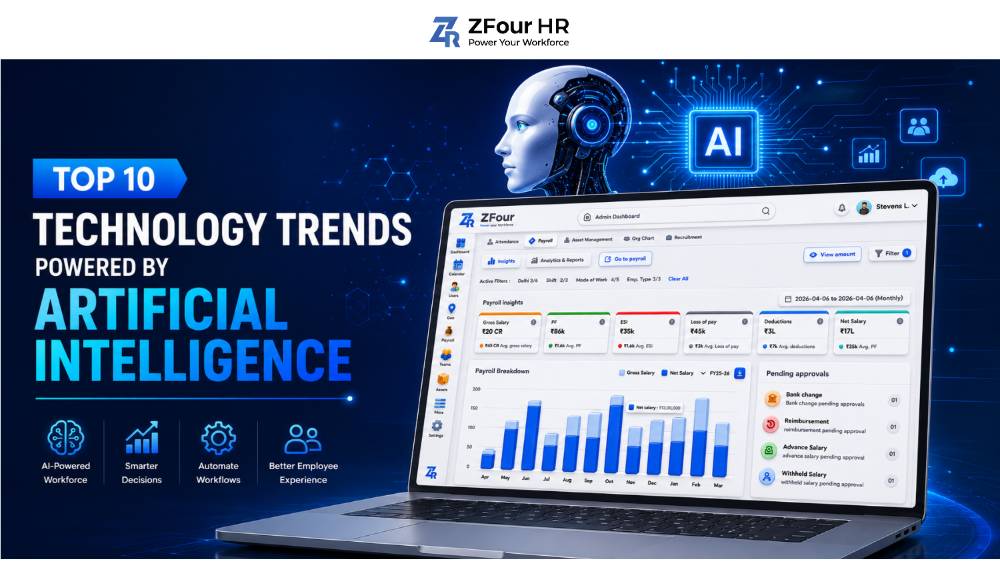
Artificial Intelligence (AI) is no longer an emerging technology—it's the foundation of modern digital transformation. From intelligent HR automation and predictive analytics to generative AI and autonomous business systems, organizations are leveraging AI to improve productivity, reduce operational costs, and make faster, data-driven decisions. In 2026, businesses that adopt AI strategically will gain a competitive advantage across every department, including HR, finance, operations, customer service, and cybersecurity.
For organizations looking to modernize workforce management, AI-powered HRMS platforms such as ZFour HRMS combine automation, analytics, payroll, attendance, compliance, and employee experience into a unified digital ecosystem.
Quick Answer: What Are the Top Technology Trends Powered by Artificial Intelligence?
The top technology trends powered by Artificial Intelligence in 2026 include Generative AI, AI Agents, Hyperautomation, Predictive Analytics, Intelligent HRMS, AI-powered Cybersecurity, Computer Vision, Intelligent Document Processing, Digital Twins, and Autonomous Decision Intelligence. These technologies are reshaping how businesses operate by automating repetitive tasks, improving decision-making, enhancing customer and employee experiences, and enabling organizations to scale efficiently. For HR teams, AI-driven platforms like ZFour HRMS are transforming payroll, attendance, recruitment, compliance, workforce planning, and employee engagement through intelligent automation and data-driven insights.
Chapter 1: The Evolution of Artificial Intelligence in Business
From Automation to Intelligent Decision-Making
Over the last decade, Artificial Intelligence has evolved from simple rule-based automation into sophisticated systems capable of learning, reasoning, predicting outcomes, and generating entirely new content. Businesses no longer rely solely on software that executes predefined commands. Today's AI-powered systems analyze patterns, detect anomalies, forecast trends, and recommend actions in real time.
This evolution has transformed nearly every industry:
Healthcare uses AI to assist in diagnostics and treatment planning.
Banks rely on AI for fraud detection and risk assessment.
Manufacturers deploy predictive maintenance to reduce equipment downtime.
Retailers personalize customer experiences using recommendation engines.
HR departments automate payroll, recruitment, attendance, and workforce analytics through intelligent HRMS platforms.
The shift from manual processes to intelligent automation is not just about efficiency—it represents a fundamental change in how organizations make decisions.
The Rise of Enterprise AI
Enterprise AI integrates multiple technologies, including:
Machine Learning (ML)
Natural Language Processing (NLP)
Computer Vision
Predictive Analytics
Knowledge Graphs
Large Language Models (LLMs)
Semantic Search
AI Agents
Together, these technologies enable businesses to process vast amounts of structured and unstructured data, delivering insights that were previously impossible to obtain manually.
For example, an AI-powered HRMS can:
Predict employee attrition.
Detect attendance anomalies.
Recommend personalized learning paths.
Automate payroll compliance.
Generate workforce reports instantly.
Answer employee queries through AI assistants.
Why AI Is Becoming a Business Necessity
Organizations adopting AI consistently report improvements in:
Operational efficiency
Customer satisfaction
Employee productivity
Compliance accuracy
Cost optimization
Decision speed
Businesses that delay AI adoption risk falling behind competitors who are leveraging intelligent automation to scale faster and operate more efficiently.
Chapter 2: Why Traditional Technology Fails in the AI Era
Traditional enterprise software was designed to record transactions and store information. Modern businesses, however, require systems that can interpret data, identify patterns, and recommend actions automatically.
The difference between these approaches is substantial.
Traditional Software vs Intelligent Platforms
Traditional systems require users to manually search for information, create reports, identify problems, and make decisions.
AI-powered systems proactively surface insights, automate workflows, and continuously improve through machine learning.
For example:
Traditional payroll software calculates salaries.
AI-powered payroll software:
detects unusual salary changes,
flags compliance risks,
predicts payroll costs,
identifies attendance anomalies,
generates management insights.
The software moves from being a passive tool to an active business advisor.
Traditional Technology vs Next-Generation AI Frameworks
Capability | Traditional Technology | Next-Generation AI Framework |
|---|---|---|
Automation | Rule-based | Self-learning automation |
Decision Making | Manual | AI-assisted |
Search | Keyword Search | Semantic Search |
User Interaction | Static Interface | Conversational AI |
Reporting | Manual Reports | Predictive Insights |
Analytics | Historical | Predictive & Prescriptive |
Compliance | Manual Checks | Automated Monitoring |
HR Operations | Reactive | Intelligent & Proactive |
Productivity | Moderate | High |
Scalability | Limited | Enterprise Scale |
ROI Tracking | Basic KPIs | Real-time Business Intelligence |
Why AI Search Is Changing Digital Visibility
Search behavior is changing rapidly.
Users increasingly expect direct answers rather than lists of links. AI-powered search experiences summarize information from multiple authoritative sources, emphasizing structured, trustworthy, and comprehensive content.
For businesses, this means content must be:
Factually accurate
Well-structured
Entity-rich
Comprehensive
Easy for AI systems to interpret
Organizations that continue publishing thin, keyword-focused pages risk losing visibility to competitors producing authoritative, AI-optimized resources.
What This Means for Businesses
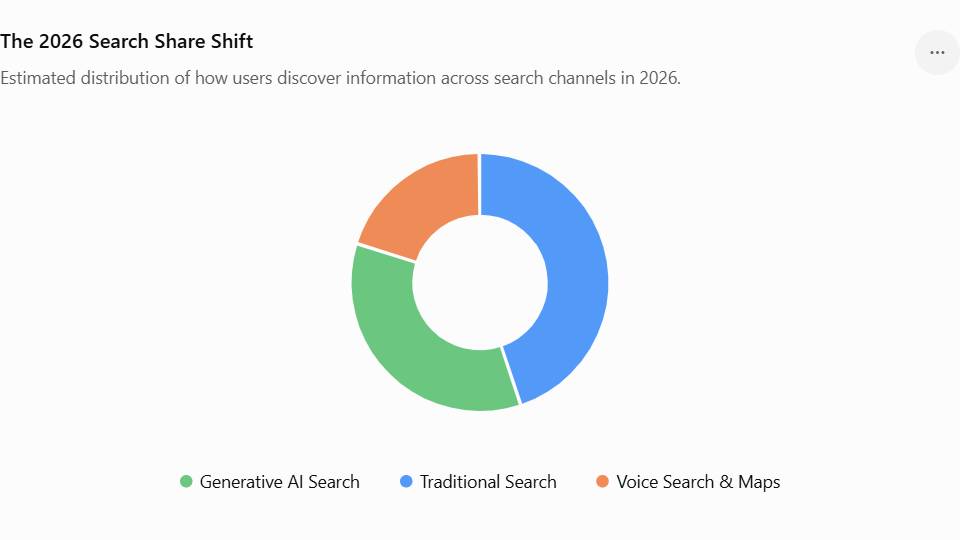
The search ecosystem is no longer dominated exclusively by traditional search engines. While conventional web search remains the largest channel, generative AI platforms are rapidly becoming a preferred way for users to discover information, compare products, and evaluate solutions. Voice search and location-based discovery continue to grow as mobile usage increases.
For businesses, this shift requires a broader optimization strategy. Instead of focusing only on ranking web pages, organizations must create structured, authoritative, and context-rich content that AI systems can understand, summarize, and cite. This involves implementing semantic markup, organizing content with clear headings, using entity-based optimization, and providing direct answers to common user questions.
Platforms such as ZFour HRMS can strengthen their digital presence by combining technical SEO with AI-ready content, ensuring visibility across both traditional search results and emerging AI-powered discovery experiences.
Chapter 3: Top 10 Technology Trends Powered by Artificial Intelligence in 2026
Artificial Intelligence has evolved beyond being a productivity tool—it is now the foundation of enterprise innovation. Organizations are no longer adopting AI simply to automate repetitive tasks; they are embedding intelligent technologies into every business function to improve agility, resilience, and decision-making. From HR and payroll to finance, manufacturing, customer service, and cybersecurity, AI-powered technologies are reshaping how businesses operate.
The following ten trends represent the most significant AI-driven innovations influencing organizations in 2026.
1. Generative AI Becomes a Business Co-Pilot
Generative AI has moved from experimental use cases to enterprise-wide adoption. Unlike traditional AI models that classify or predict data, Generative AI creates new content, including text, code, reports, images, workflows, and business documentation.
Organizations now use Generative AI to:
Draft policies and SOPs
Generate HR communications
Create job descriptions
Summarize meetings
Produce marketing content
Assist software development
Automate documentation
For HR teams, Generative AI reduces administrative workload while enabling professionals to focus on employee engagement and strategic workforce planning.
2. AI Agents Transform Business Operations
AI Agents are intelligent systems capable of performing multi-step tasks with minimal human intervention. Instead of responding to individual prompts, they can analyze objectives, execute workflows, retrieve information, and collaborate with other systems.
Examples include:
HR virtual assistants answering employee queries
Finance agents reconciling invoices
Recruitment assistants screening resumes
IT support agents resolving common issues
Customer support agents managing tickets
Unlike traditional chatbots, AI Agents continuously reason through tasks and adapt based on context.
3. Hyperautomation Across Enterprise Functions
Hyperautomation combines Artificial Intelligence, Robotic Process Automation (RPA), workflow orchestration, and analytics to automate entire business processes rather than isolated activities.
Typical hyperautomation scenarios include:
Employee onboarding
Payroll processing
Leave approvals
Invoice management
Vendor onboarding
Compliance reporting
Procurement workflows
Businesses implementing hyperautomation experience faster turnaround times, fewer manual errors, and improved operational consistency.
4. Predictive Analytics for Smarter Decisions
Historical reports explain what happened. Predictive Analytics estimates what is likely to happen next.
By analyzing historical and real-time data, AI models forecast:
Employee turnover
Hiring requirements
Payroll expenses
Sales demand
Inventory levels
Customer behavior
Project risks
Rather than reacting to problems, organizations can proactively plan interventions based on predictive insights.
5. Intelligent Document Processing (IDP)
Every enterprise manages thousands of structured and unstructured documents.
AI-powered Intelligent Document Processing extracts, validates, categorizes, and processes information from:
Payslips
Invoices
Contracts
Tax forms
Employee documents
Compliance certificates
Identity proofs
This significantly reduces manual verification while improving accuracy and audit readiness.
6. AI-Powered Cybersecurity
Cyber threats continue to evolve in complexity.
Artificial Intelligence strengthens security by identifying suspicious activity before attacks occur.
Capabilities include:
Threat detection
User behavior analysis
Network monitoring
Fraud detection
Identity verification
Risk scoring
Automated incident response
AI enables organizations to respond to cyber risks much faster than traditional rule-based systems.
7. Computer Vision in Enterprise Workflows
Computer Vision enables machines to understand images and videos.
Business applications include:
Manufacturing quality inspection
Warehouse monitoring
Retail analytics
Identity verification
Attendance recognition
Workplace safety monitoring
Organizations increasingly use Computer Vision alongside IoT devices to automate inspections and improve operational visibility.
8. Autonomous Business Intelligence
Business Intelligence platforms are becoming self-service and AI-assisted.
Instead of manually building reports, executives can ask natural-language questions such as:
Why did payroll costs increase this month?
Which department has the highest absenteeism?
What factors influence employee retention?
AI automatically retrieves data, identifies trends, and generates actionable insights, making analytics accessible to non-technical users.
9. Digital Twins for Business Simulation
A Digital Twin is a virtual representation of a physical process, system, or organization.
Companies use Digital Twins to simulate:
Manufacturing operations
Supply chains
Workforce planning
Logistics networks
Facility management
These simulations help organizations evaluate scenarios, optimize processes, and reduce operational risk before implementing changes in the real world.
10. AI-Powered HR Technology
Human Resources is becoming one of the fastest-growing areas for AI adoption.
Modern HR platforms integrate Artificial Intelligence into:
Recruitment
Attendance
Payroll
Performance management
Learning and development
Employee engagement
Workforce analytics
Compliance monitoring
Rather than replacing HR professionals, AI enhances decision-making and automates repetitive tasks, allowing HR teams to focus on people strategy.
AI Technology Adoption Across Industries
Industry | Primary AI Use Cases | Business Benefits | HR & Workforce Impact |
|---|---|---|---|
HR & Payroll | Payroll automation, workforce analytics, recruitment | Faster processing, reduced manual work | Improved employee experience and compliance |
Healthcare | Diagnostics, patient scheduling, medical imaging | Better care quality, operational efficiency | Workforce scheduling and credential management |
Banking & Finance | Fraud detection, risk assessment, customer support | Enhanced security and faster decisions | Automated compliance and employee productivity |
Manufacturing | Predictive maintenance, quality inspection | Reduced downtime, higher output | Safer workforce and optimized shift planning |
Retail & E-commerce | Demand forecasting, personalization | Higher conversions and inventory optimization | Smarter staffing and sales forecasting |
Logistics | Route optimization, warehouse automation | Faster deliveries and lower costs | Efficient fleet and workforce management |
SaaS & Technology | AI assistants, software automation | Improved product innovation | Data-driven performance management |
Education | Personalized learning, automated administration | Better learning outcomes | Faculty scheduling and resource planning |
Real Estate | Property recommendations, market analysis | Faster transactions and customer engagement | Sales team performance analytics |
Government | Citizen services, document automation | Improved public service delivery | Workforce planning and compliance reporting |
Chapter 4: Artificial Intelligence in HR and Workforce Management
While AI is transforming every business function, Human Resources has emerged as one of the most impactful areas for intelligent automation. Organizations are shifting from reactive HR operations to predictive, data-driven workforce management.
Smarter Recruitment
Traditional recruitment often involves manual resume screening, repetitive communication, and lengthy hiring cycles.
AI improves recruitment by:
Ranking candidates based on job fit.
Matching skills with role requirements.
Reducing screening time.
Identifying high-potential talent.
Supporting structured interview planning.
Recruiters spend less time on administrative tasks and more time engaging with qualified candidates.
Intelligent Payroll Processing
Payroll accuracy directly affects employee trust and regulatory compliance.
AI-powered payroll systems assist by:
Detecting payroll anomalies.
Automating salary calculations.
Validating statutory deductions.
Reducing processing errors.
Supporting faster payroll cycles.
Organizations benefit from greater accuracy while minimizing compliance risks.
Attendance and Leave Optimization
AI enhances attendance management through intelligent monitoring and analytics.
Capabilities include:
Attendance pattern analysis.
Shift optimization.
Overtime prediction.
Leave trend analysis.
Workforce utilization insights.
Managers gain greater visibility into workforce availability and scheduling efficiency.
Performance Management Through Data
Annual reviews are gradually being replaced by continuous performance management.
AI enables organizations to:
Monitor performance trends.
Recommend personalized learning opportunities.
Identify high performers.
Detect engagement risks.
Support objective evaluation using measurable data.
This encourages continuous development rather than periodic assessments.
Workforce Analytics
Modern HR decisions increasingly rely on data rather than assumptions.
AI-powered workforce analytics helps leaders answer questions such as:
Which departments experience higher turnover?
What factors contribute to absenteeism?
Which skills are missing across teams?
Where should hiring investments be prioritized?
Which employees may require additional support?
These insights improve workforce planning and organizational resilience.
How ZFour HRMS Supports AI-Driven HR
Organizations seeking to modernize HR operations can leverage solutions such as ZFour HRMS, which brings together essential workforce functions on a unified cloud platform.
Typical capabilities include:
Payroll management
Attendance tracking
Leave management
Recruitment workflows
Employee self-service
Performance management
HR analytics
Compliance support
Mobile workforce management
Related resources on the ZFour website can naturally connect readers to topics such as Payroll Management, Attendance Management, Recruitment, Employee Self-Service, Performance Management, Pricing, Book a Demo, and Contact pages to explore these capabilities in more detail.
Authoritative Resources
For readers who want to deepen their understanding of AI and modern web standards, consider consulting:
Official guidance on AI and search from Google Search Central.
Technical specifications from Schema.org for structured data.
Web performance recommendations from Google Core Web Vitals.
AI research and best practices published by OpenAI, Microsoft AI, and the World Economic Forum.
Chapter 5: A Practical Blueprint for Adopting AI-Powered Technologies in Business
Artificial Intelligence is no longer reserved for global enterprises with billion-dollar budgets. Today, organizations of every size—from startups and SMEs to large enterprises—can adopt AI strategically to improve productivity, customer experience, workforce management, and business intelligence. However, successful AI adoption requires more than implementing new software. It demands a structured roadmap that aligns technology with business objectives.
The following operational blueprint provides a practical framework for organizations looking to embrace AI-driven transformation while minimizing risk and maximizing return on investment.
Step 1: Assess Business Readiness
Every successful AI initiative begins with a comprehensive assessment of existing business processes. Organizations should identify repetitive, time-consuming, and error-prone activities that consume valuable employee time.
Typical assessment areas include:
Payroll processing
Employee attendance tracking
Recruitment workflows
Leave approvals
Compliance reporting
Customer support
Sales forecasting
Financial reporting
Rather than automating every process immediately, prioritize those with the highest operational impact.
Explore how ZFour HRMS simplifies workforce operations through intelligent automation.
Step 2: Build a Strong Data Foundation
Artificial Intelligence performs best when supported by accurate, structured, and consistent data. Poor-quality data leads to unreliable predictions and ineffective automation.
Organizations should:
Standardize employee records
Eliminate duplicate information
Validate payroll data
Maintain accurate attendance logs
Organize compliance documents
Implement role-based data access
A clean data environment enables AI models to generate meaningful insights rather than inaccurate assumptions.
Step 3: Implement AI Where It Creates Immediate Value
Many businesses attempt to deploy AI across every department simultaneously. This often leads to unnecessary complexity.
Instead, focus on high-impact areas such as:
HR automation
Payroll processing
Attendance management
Employee self-service
Recruitment
Performance management
Business analytics
Quick wins build organizational confidence and encourage wider adoption.
Step 4: Continuously Optimize Through Analytics
AI is not a one-time implementation. Modern intelligent systems continuously improve by analyzing new data and identifying opportunities for optimization.
Organizations should regularly monitor:
Productivity metrics
Employee engagement
Recruitment efficiency
Payroll accuracy
Compliance status
Workforce utilization
Business KPIs
Continuous improvement ensures AI remains aligned with changing business priorities.
Measuring the ROI of Artificial Intelligence
Investing in AI should produce measurable business outcomes rather than simply introducing new technology.
Key performance indicators include:
Business Metric | Expected Impact |
|---|---|
Payroll Processing Time | Reduced by 50–80% |
Administrative Workload | Significant reduction |
Compliance Accuracy | Higher consistency |
Recruitment Cycle | Faster hiring decisions |
Employee Experience | Improved satisfaction |
Reporting Speed | Near-real-time insights |
Operational Costs | Long-term reduction |
Decision Quality | More data-driven outcomes |
The true value of AI lies not only in automation but in enabling employees to focus on strategic work instead of repetitive administrative tasks.
Responsible Artificial Intelligence
As organizations increasingly rely on AI, responsible governance becomes essential.
Key principles include:
Transparency
Employees should understand when AI assists decision-making and how recommendations are generated.
Privacy
Sensitive employee and customer information must be protected through strong security practices, access controls, and compliance with applicable data protection laws.
Human Oversight
AI should support human decision-makers rather than replace them entirely. Critical decisions involving hiring, promotions, compliance, or employee relations should include human review.
Continuous Monitoring
Organizations should regularly evaluate AI models to ensure they remain accurate, unbiased, and aligned with evolving business requirements.
Why AI and HR Technology Will Continue to Evolve Together
Human Resources has shifted from an administrative function to a strategic business partner. Modern organizations expect HR teams to deliver insights that influence workforce planning, employee engagement, productivity, and organizational growth.
AI enables HR professionals to move beyond manual administration by providing:
Predictive workforce planning
Intelligent employee analytics
Automated compliance support
Faster recruitment
Continuous performance insights
Personalized employee experiences
Cloud-based platforms like ZFour HRMS integrate these capabilities into a unified environment, enabling businesses to modernize workforce management while maintaining operational efficiency.
Conclusion
Artificial Intelligence is no longer a future concept—it has become a strategic necessity for organizations seeking sustainable growth in an increasingly competitive digital landscape. From Generative AI and intelligent automation to predictive analytics and AI-powered HR platforms, modern technologies are transforming the way businesses operate, collaborate, and innovate.
For Human Resources, AI represents an opportunity to move beyond administrative tasks toward strategic workforce planning, employee engagement, and data-driven decision-making. Organizations that adopt AI thoughtfully will be better positioned to improve operational efficiency, strengthen compliance, enhance employee experiences, and respond more effectively to changing business demands.
As AI capabilities continue to evolve, businesses should focus not only on implementing new technologies but also on building strong data foundations, responsible governance practices, and a culture of continuous improvement. Platforms such as ZFour HRMS demonstrate how intelligent workforce management can support organizations throughout this transformation by bringing payroll, attendance, recruitment, performance management, compliance, and analytics into a unified cloud-based ecosystem.
The future belongs to organizations that combine human expertise with intelligent technology. By embracing AI strategically today, businesses can create more agile, productive, and resilient workplaces prepared for tomorrow's opportunities.