Opportunity Cost in HRMS & Payroll (2026 Guide)
QUICK ANSWER
Opportunity cost is often overlooked because it is not visible in financial reports. However, businesses that focus only on direct costs may miss significant long-term value.
By analyzing both visible and hidden costs, organizations can make more balanced and strategic decisions. In HRMS and payroll, this means choosing systems that improve efficiency, accuracy, and scalability rather than relying on short-term cost savings.
WHAT IS OPPORTUNITY COST
Every decision in business carries a cost, but not all of those costs are visible. When organizations evaluate expenses, they usually focus on what they are spending in terms of money, time, or resources. However, the more important cost often lies in what they are giving up.
This hidden dimension is what makes opportunity cost one of the most important concepts in modern decision-making.
Opportunity cost refers to the value of the next best alternative that is not chosen when a decision is made. It represents the benefit that could have been gained if a different option had been selected.
In simple terms, it answers one question:
👉 What did you lose by not choosing the better option?
In areas like HRMS and payroll, where efficiency and accuracy directly impact employee experience and business outcomes, understanding opportunity cost becomes essential.
OPPORTUNITY COST FORMULA
Opportunity Cost = Return of Next Best Option – Return of Chosen Option
Understanding the Result
Result | Meaning |
Positive | A better option was missed |
Negative | The chosen option was better |
Zero | Both options deliver equal value |
KEY CHARACTERISTICS OF OPPORTUNITY COST
Characteristic | Explanation |
Future-focused | Helps guide better decisions |
Comparative | Based on available alternatives |
Includes hidden costs | Goes beyond financial metrics |
Strategic | Supports long-term planning |
WHY OPPORTUNITY COST IS IMPORTANT
Opportunity cost plays a vital role in helping businesses make informed decisions.
- It improves decision-making by encouraging comparison between alternatives
- It helps allocate resources more efficiently
- It reveals hidden losses like wasted time and missed opportunities
- It supports long-term strategic thinking
OPPORTUNITY COST IN BUSINESS
In business, opportunity cost influences decisions related to investments, technology adoption, and resource allocation.
For example, a company may choose to invest in marketing instead of product development. While marketing may deliver quick results, the opportunity cost could be long-term product improvement.
Understanding this trade-off helps businesses make balanced decisions.
OPPORTUNITY COST IN HR
HR decisions directly affect employee performance and organizational growth.
HR Area | Decision |
Hiring | Recruit vs automate |
Training | Upskill vs hire |
HRMS | Manual vs software |
Retention | Engagement vs expansion |
Each of these choices involves trade-offs that can be evaluated using opportunity cost.
OPPORTUNITY COST IN HRMS AND PAYROLL
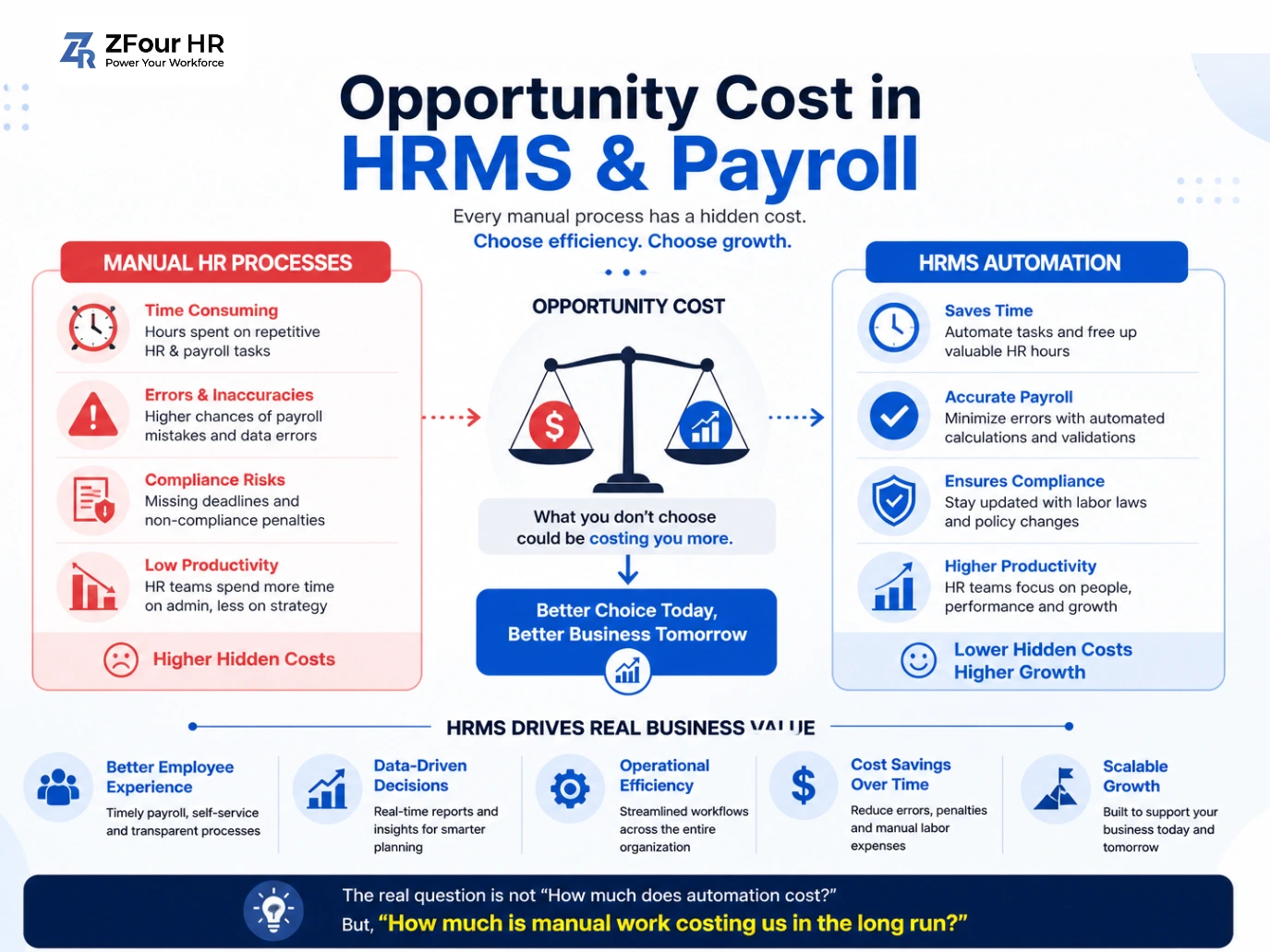
HRMS and payroll systems are central to HR operations. The decision between manual processes and automation has a direct impact on efficiency and accuracy.
Manual Payroll vs HRMS
Factor | Manual Payroll | HRMS |
Time | High | Low |
Errors | High | Low |
Compliance | Risky | Secure |
Productivity | Low | High |
👉 The opportunity cost of manual payroll includes wasted time, increased errors, and reduced productivity.
DETAILED ROLE OF HRMS IN REDUCING OPPORTUNITY COST
HRMS is no longer just a tool—it is a strategic system that reduces opportunity cost across HR operations.
When HR teams rely on manual systems, they spend significant time on repetitive tasks such as attendance tracking, payroll processing, and record management. This limits their ability to focus on strategic activities like employee engagement and workforce planning.
By automating these processes, HRMS allows teams to shift their focus toward high-value work. This improves efficiency and reduces hidden losses.
For example, instead of spending hours preparing payroll reports, HR teams can analyze employee performance and improve productivity.
IMPACT OF OPPORTUNITY COST ON EMPLOYEE EXPERIENCE
Opportunity cost also affects employees directly.
When organizations rely on inefficient systems, employees may experience:
- Delayed salary payments
- Inaccurate payroll calculations
- Lack of transparency
- Slow HR processes
These issues reduce employee trust and satisfaction.
With HRMS, businesses can:
- Ensure accurate and timely payroll
- Provide employee self-service portals
- Improve communication
- Reduce dependency on HR teams
👉 The opportunity cost of poor systems is the loss of employee satisfaction and retention.
OPPORTUNITY COST IN DECISION-MAKING FOR GROWING BUSINESSES
For growing businesses, every decision has long-term implications.
Many startups delay investing in HRMS to save costs. However, as the business grows:
- Manual processes become difficult to manage
- Errors increase
- HR workload becomes overwhelming
👉 The opportunity cost is scalability.
Investing in HRMS early helps businesses:
- Build structured processes
- Scale efficiently
- Reduce long-term operational costs
HIDDEN COSTS OF MANUAL HR PROCESSES
Organizations often underestimate the hidden costs of manual systems.
These include:
- Time loss due to repetitive tasks
- Productivity loss from inefficient processes
- Error correction costs in payroll
- Compliance risks due to missed regulations
- Employee turnover caused by poor experience
👉 These hidden costs are often higher than the cost of automation.
HOW AUTOMATION MINIMIZES OPPORTUNITY COST
Automation plays a key role in reducing opportunity cost.
With automation:
- Tasks are completed faster
- Errors are minimized
- Data is available in real time
- Decision-making becomes easier
In HRMS and payroll:
- Attendance is tracked automatically
- Payroll is processed accurately
- Compliance is managed efficiently
This allows organizations to focus on growth instead of administrative work.
STRATEGIC ADVANTAGE OF UNDERSTANDING OPPORTUNITY COST
Businesses that understand opportunity cost gain a competitive advantage.
They:
- Make better investment decisions
- Allocate resources efficiently
- Avoid unnecessary expenses
- Focus on long-term growth
In HR, this leads to better tools, improved employee experience, and higher productivity.
PRACTICAL FRAMEWORK FOR HR DECISIONS
HR teams can use opportunity cost as a decision-making framework:
- Identify the decision (e.g., manual payroll vs HRMS)
- List available alternatives
- Evaluate outcomes (time, cost, efficiency)
- Consider hidden costs
- Choose the option with maximum long-term value
FINAL INSIGHT
Opportunity cost is not always visible, but it is always present.
Every time a business delays automation or continues inefficient processes, it pays a hidden price.
This leads to one important conclusion for modern businesses:
👉 The real question is not “How much does automation cost?”
👉 But “How much is manual work costing us in the long run?”
TYPES OF OPPORTUNITY COST
Explicit Cost
Type | Example |
Financial | Salaries |
Direct | Software costs |
Measurable | Vendor payments |
Implicit Cost
Type | Example |
Time loss | Manual work |
Productivity loss | Delays |
Employee impact | Burnout |
OPPORTUNITY COST VS SUNK COST
Factor | Opportunity Cost | Sunk Cost |
Focus | Future | Past |
Importance | High | Low |
Example | HRMS decision | Old investment |
OPPORTUNITY COST VS TRADE-OFF
Factor | Trade-Off | Opportunity Cost |
Meaning | Choice | Value of lost option |
Nature | Qualitative | Quantitative |
STEPS TO CALCULATE OPPORTUNITY COST
- Identify alternatives
- Estimate expected returns
- Include hidden costs
- Apply the formula
- Compare outcomes
OPPORTUNITY COST IN HRMS IMPLEMENTATION
Companies that delay HRMS adoption often face inefficiencies, lack of visibility, and higher operational costs.
👉 The opportunity cost is reduced productivity and poor decision-making.
OPPORTUNITY COST IN PAYROLL
Payroll errors and delays directly impact employee trust.
Automated systems ensure accuracy and reliability.
👉 The opportunity cost of manual payroll is time loss and reduced employee confidence.
COMMON MISTAKES
- Ignoring hidden costs
- Focusing only on short-term savings
- Delaying important decisions
- Not comparing alternatives
BENEFITS
- Better decision-making
- Improved efficiency
- Higher productivity
- Strategic growth
LIMITATIONS
- Difficult to measure intangible factors
- Depends on assumptions
- Time-consuming
FUTURE OF OPPORTUNITY COST
With AI and HR analytics, opportunity cost analysis will become more accurate and data-driven.
HR will continue to evolve as a strategic function within organizations.
CONCLUSION
Opportunity cost is more than just a concept—it’s a practical tool for making smarter business decisions.
In HRMS and payroll, it reveals the hidden impact of choosing manual processes over automation. What may seem like a cost-saving decision today can lead to inefficiencies, errors, and missed growth opportunities in the long run.
By understanding and applying opportunity cost, organizations can:
- Improve operational efficiency
- Reduce payroll errors and compliance risks
- Enhance employee experience and transparency
- Drive sustainable, long-term business growth
The real question isn’t how much HRMS costs—👉 it’s how much manual processes are costing your business every day.
Ready to stop losing time and money?
Manual HR processes cost more than you think.
Switch to ZFour HRMS and automate payroll, attendance, and compliance with ease.