Multi-State Payroll Compliance India: The 2026 Reality
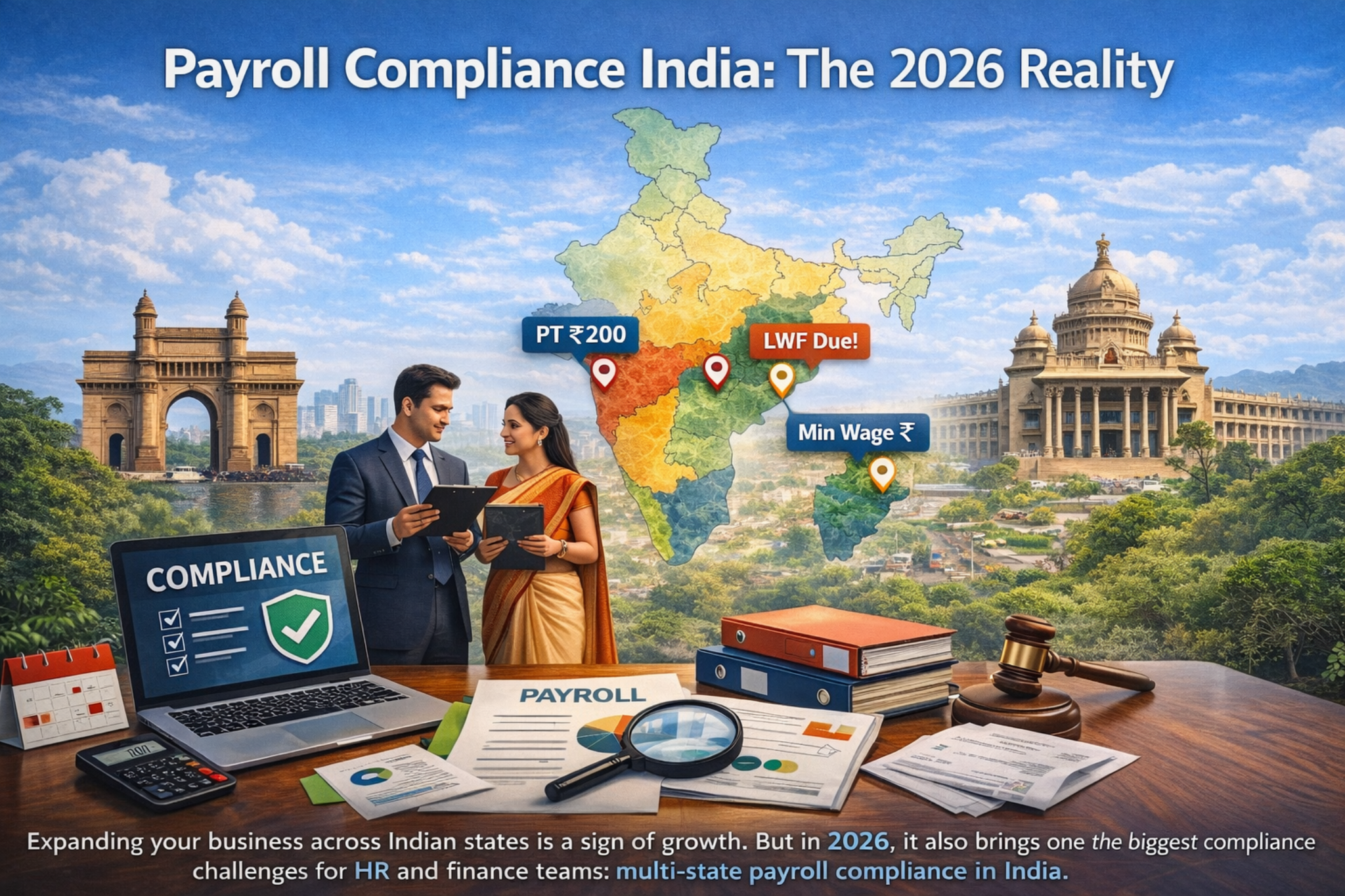
Expanding your business across Indian states is a sign of growth. But in 2026, it also brings one of the biggest compliance challenges for HR and finance teams: multi state payroll compliance in India.
Despite national labour codes, payroll laws in India are not uniform. Rules for Professional Tax, Labour Welfare Fund, and Minimum Wages still depend on state governments.
One wrong calculation in one state can result in penalties, audit notices, or employee disputes.
This blog explains how multi state payroll compliance in India actually works, where companies make mistakes, and how to stay compliant in 2026.
Why Multi-State Payroll Compliance in India Is Still Complex?
Many businesses assume that national labour codes mean one payroll system for all states.
That assumption is risky.
In reality, companies operating in multiple states must comply with:
- State-specific Professional Tax laws
- Different Labour Welfare Fund contribution cycles
- State-notified minimum wages
- Mandatory skill-based wage classification
A payroll rule that is valid in Maharashtra may be illegal in Karnataka or West Bengal Zfour
Payroll Compliance Areas That Change From State to State
Payroll Component | Governed By | Compliance Risk |
Professional Tax | State Government | Wrong slab deduction |
Labour Welfare Fund | State Government | Missed deadlines |
Minimum Wages | State Notification | Underpayment |
Skill Classification | State Labour Dept. | Audit objections |
These are the top triggers for labour inspections in India.
Professional Tax Rules Under Multi-State Payroll
Professional Tax is one of the most common payroll error points because every state uses a different calculation logic.
Professional Tax Slabs by State (2026 Examples)
State | PT Rule | Special Condition |
Maharashtra | ₹200/month if income > ₹10,000 | ₹300 in February |
Karnataka | ₹200 flat | Income ≥ ₹25,000 |
West Bengal | ₹110–₹200 slabs | Multiple income levels |
Manual payroll systems often fail to detect an employee’s actual work location. When the wrong state rule is applied, the error repeats every month—creating ongoing compliance risk for multi-state companies.
Indian labour law framework...
Labour Welfare Fund: A Silent Compliance Risk
Labour Welfare Fund (LWF) is not deducted monthly in most states. That’s why it is frequently missed.
Labour Welfare Fund Contribution Frequency by State
State | Contribution Cycle | Typical Due Months |
Karnataka | Annual | January |
Tamil Nadu | Annual | January |
Maharashtra | Half-Yearly | June, December |
Gujarat | Half-Yearly | June, December |
Labour Welfare Fund deadlines are frequently overlooked, making LWF non-compliance one of the most common issues flagged during state labour inspections.
Labour welfare and wage laws...
Minimum Wages: National Floor vs State Enforcement
India has a National Floor Wage, but it is only advisory. States are free to notify higher enforceable minimum wages.
Minimum Wage Compliance Difference
Aspect | Central Govt | State Govt |
Wage Authority | Advisory | Legally enforceable |
Skill Categories | Generic | Mandatory |
Inspection Risk | Low | High |
In real payroll audits, inspectors focus on state-notified minimum wages, not the national floor wage. This means employers must follow state-specific skill categories and wage rates exactly, as errors in classification or underpayment can quickly lead to penalties or back-pay liabilities.
Minimum wages notified by states..
Why Manual Payroll Fails in Multi-State Operations?
As businesses scale across states, payroll complexity increases faster than headcount.
Manual or Excel-based payroll fails because it:
- Uses static tax slabs
- Misses LWF deadlines
- Applies outdated wage notifications
- Cannot support state-wise audits
In 2026, payroll compliance is system-driven, not effort-driven.
How to Stay Compliant With Multi State Payroll in 2026
To manage multi state payroll compliance in India, businesses should:
- Track employee work location accurately
- Apply state-specific rules automatically
- Monitor Professional Tax and LWF deadlines
- Maintain audit-ready payroll records
Final Takeaway
Multi-state expansion should not create compliance anxiety.
In 2026, businesses that grow safely are those that:
- Respect state-level labour laws
- Replace manual payroll with automation
- Treat compliance as a growth enabler
Grow across states. Stay compliant everywhere.
Track state-wise payroll obligations, stay on top of PT and LWF deadlines,
and remain audit-ready with a single system.
Talk to a Payroll Compliance Expert