Migrant Worker Compliance India 2026: What Employers Must Know
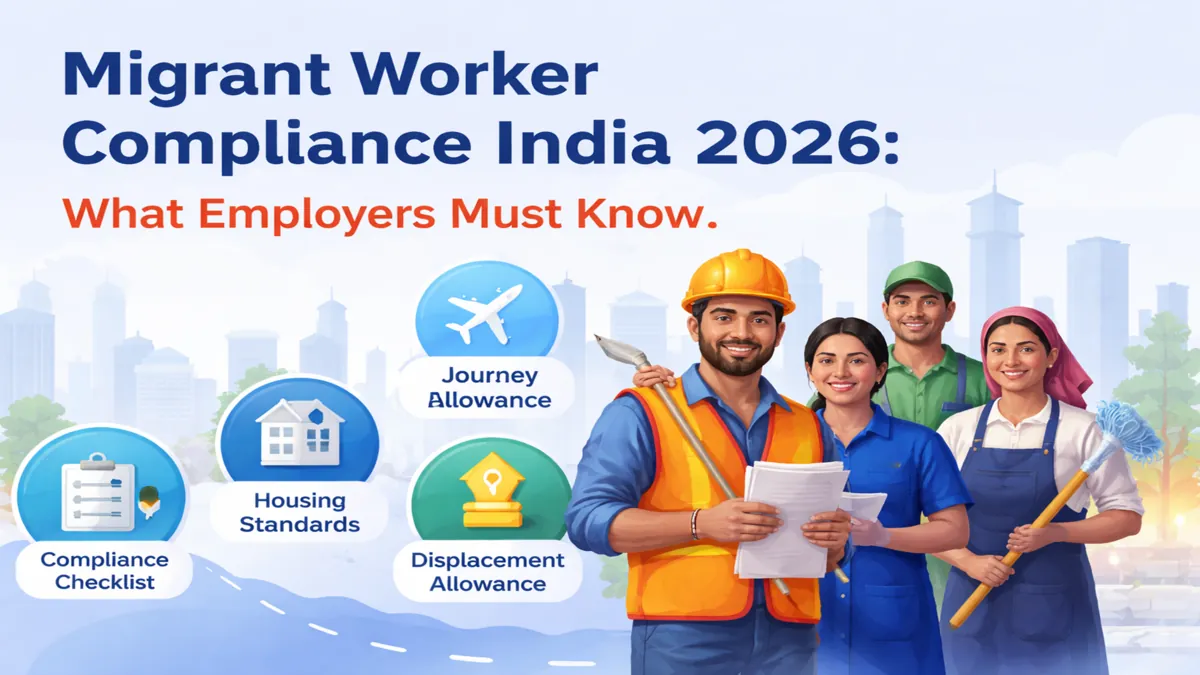
Hiring workers from other states has always been common in India. What’s changed in 2026 is how clearly the law now defines your responsibility toward them.
Under the latest labour framework, migrant workers are no longer an informal workforce. They are legally visible, protected, and auditable.
If your company employs people from other states—and most growing businesses do—Migrant Worker Compliance India 2026 is something you cannot ignore anymore.
This guide breaks down the rules in simple language, explains where companies usually slip up, and shows how to stay compliant without turning HR into a paperwork factory.
Why Migrant Worker Compliance India 2026 Is Now Mandatory for Employers?
The Occupational Safety, Health and Working Conditions (OSH) Code, 2020 is fully enforceable in 2026. One of its biggest shifts is how it treats inter-state migrant workers.
Earlier, many businesses assumed migrant laws applied only to large construction sites. That assumption is now risky.
If your organization:
- Employs 10 or more workers, and
- Has employees who moved from another state for work
You fall under migrant worker compliance—even if you are an SME.
As per the Ministry of Labour and Employment, the OSH Code consolidates multiple labour laws and strengthens migrant worker protections.
Who Qualifies Under the Migrant Worker Compliance India 2026 Rules?
An employee is considered an Inter-State Migrant Worker if they:
- Move from one state to another for employment
- Earn up to ₹18,000 per month
- Are hired directly or through a contractor
This applies across industries like logistics, manufacturing, hospitality, facility management, and construction.
Many employers are surprised to learn that even white-collar contract staff can fall under this definition.
Migrant Worker Compliance India 2026 and the Journey Allowance Rule
This is the most misunderstood—and most ignored—requirement.
What the law requires
Employers must pay for to-and-fro travel of migrant workers to their home state at least once every 12 months.
Eligibility
- Worker completes 180 days of continuous service
- Home state and work state are different
This is not a benefit or company policy. It is a statutory entitlement.
Failure to provide journey allowance is treated as welfare denial, not a payroll error.
Journey Allowance: Cost vs Risk
Aspect | If Ignored | If Planned |
Compliance visibility | None | Clear |
Inspection risk | High | Low |
Legal exposure | Severe | Controlled |
Employee trust | Damaged | Improved |
Migrant Worker Compliance India 2026: Displacement Allowance Explained
At the time of recruitment, employers must pay a one-time Displacement Allowance.
Amount payable
- 50% of monthly wages, or
- ₹75, whichever is higher
Even though the amount seems small, missing it is a technical violation that inspectors actively check.
Housing Standards Under Migrant Worker Compliance India 2026
The OSH Code mandates “suitable accommodation” for migrant workers wherever applicable.
Inspectors generally evaluate:
- Overcrowding
- Hygiene and sanitation
- Drinking water availability
- Ventilation and safety
The biggest issue is not infrastructure—it’s lack of documentation.
Housing Compliance Snapshot
Area Checked | Why It Matters |
Occupancy records | Prevents overcrowding |
Sanitation logs | Health compliance |
Water access | Welfare requirement |
Audit readiness | Inspection safety |
Migrant Worker Compliance India 2026 and Welfare Portability
Migrant workers often lose access to welfare schemes when they move states. The 2026 framework focuses strongly on benefit portability.
One Nation, One Ration Card (ONORC)
Under ONORC, migrant workers can access Public Distribution System (PDS) benefits in their work state.
Maintaining accurate worker location data helps employers support compliance during inspections.
BOCW Cess Fund for Construction Employers
Construction employers must contribute to the Building and Other Construction Workers (BOCW) Welfare Fund.
This fund supports:
- Medical assistance
- Education benefits
- Housing schemes
Grievance Redressal Requirements in Migrant Worker Compliance India 2026
The law mandates that migrant workers must have access to a toll-free grievance mechanism.
Labour officers typically verify:
- Whether a grievance system exists
- Language accessibility
- Proof of resolution
Digital and WhatsApp-based grievance systems are now considered best practice.
Common Mistakes Companies Make Under Migrant Worker Compliance India 2026
Most violations happen due to:
- No journey allowance tracking
- Missed displacement allowance
- Poor housing records
- Ignored welfare portability
- Heavy dependence on Excel
These are process gaps, not intent gaps.
Migrant Worker Compliance India 2026
Migrant workers are no longer a grey area in Indian labour law.
Migrant Worker Compliance India 2026 requires employers to actively manage:
- Journey allowance
- Displacement allowance
- Housing standards
- Welfare portability
- Grievance redressal
The law is clear. Enforcement is increasing. Being unprepared is now the biggest risk.
Understand how Zfour supports statutory compliance for Indian employers