Hidden Costs of Old HRMS in India: Why Switching Saves Crores?

Manual payroll and compliance processes often increase the hidden costs of old HRMS in India, especially when businesses struggle to keep up with evolving HR compliance requirements in India
But what if this comfort is silently draining ₹3–5 crore every year?
The real cost of staying on an outdated HRMS is not visible on any invoice. It hides inside delayed hiring, manual HR work, compliance penalties, poor analytics, and rising employee attrition.
When you calculate these distributed losses together, the picture changes completely.
Staying with an old HRMS is not a neutral decision. It is a financial liability.
How Hidden Costs of Old HRMS in India Increase Every Year?
Outdated HRMS systems don’t fail overnight — they decay gradually.
This slow decline is one of the hidden costs of old HRMS in India, where in Year 1, teams begin creating small workarounds to manage system gaps and operational limitations.
In Year 2, additional tools and consultants are added. By Year 3, HR operations become fragmented, expensive, and risky.
Real insight from Indian mid-size firms (200–500 employees):
- HR teams spend 30–40% of their time on manual tasks
- Compliance errors start appearing regularly
- Hiring speed falls behind competitors
- Employee frustration rises, leading to higher attrition
These costs compound quietly — until they reach ₹300–500 lakh per year.
The Biggest Hidden Costs You’re Paying Right Now
1. HR Inefficiency & Manual Workload
Without automation, HR teams spend thousands of hours on repetitive tasks like payroll verification, leave approvals, attendance correction, and compliance reporting.
Analytics Snapshot (200-employee company):
- HR inefficiency cost: ₹1.1 crore/year
- Lost strategic value: ₹30–50 lakh/year
That’s time HR could spend on retention, culture, performance, and growth — but instead, they’re stuck in spreadsheets.
2. Tool Sprawl & External Consultant Costs
When HRMS can’t handle everything, companies buy multiple tools:
- Recruitment software
- Asset tracking tools
- Field tracking apps
- Payroll & compliance consultants
Each tool adds cost, data conflicts, and integration headaches.
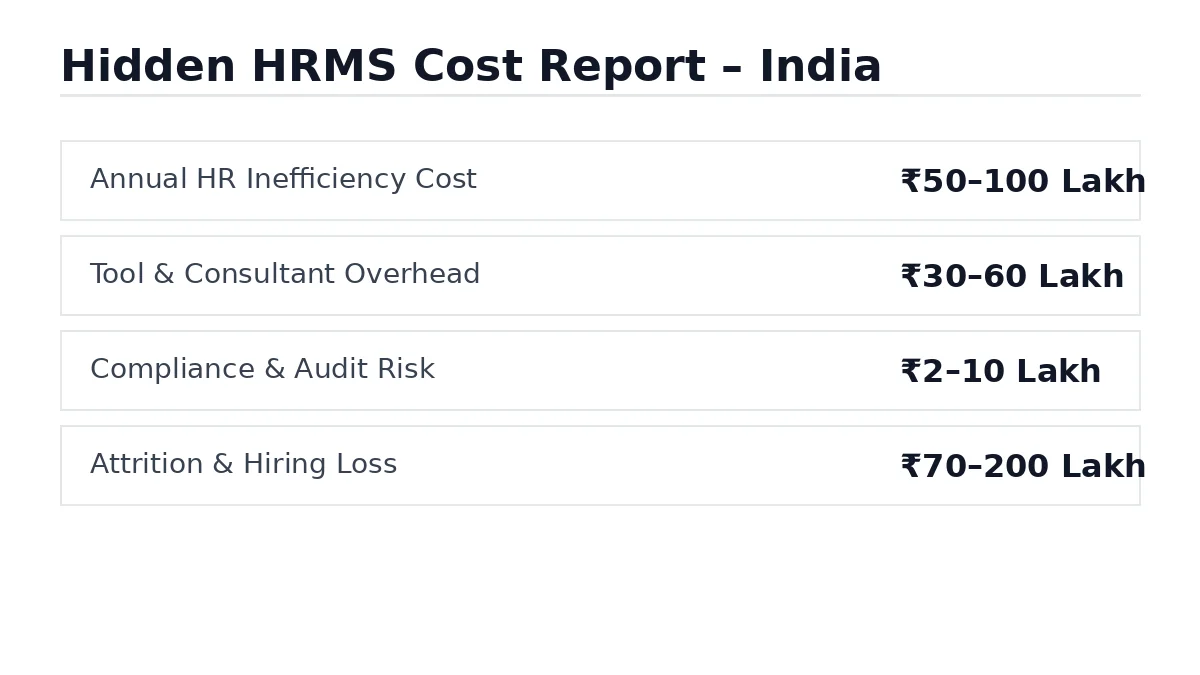
Average annual tool + consultant cost: ₹30–60 lakh
A single, integrated HRMS eliminates this chaos almost entirely.
3. Compliance Penalties & Audit Disruptions
Manual compliance leads to PF, ESI, TDS, and Professional Tax errors. Even minor mistakes trigger penalties, interest, and stressful audits.
Compliance Analytics (India):
- Routine penalties: ₹2–8 lakh/year
- Audit disruptions (amortized): ₹1–5 lakh/year
- Emergency consultant fees during audits: ₹2–5 lakh
Modern HRMS with automated compliance reduces this risk to near zero.
4. Slow Hiring & Talent Loss
Old HRMS slows hiring dramatically.
- Your time-to-hire: 8–10 weeks
- Competitors with modern HRMS: 4–5 weeks
Result? You lose 30–40% of top candidates.
Estimated impact:
- Lost productivity per top hire: ₹30–50 lakh
- Annual talent loss impact: ₹1.5–5 crore
Hiring speed is no longer an HR metric — it’s a business growth lever.
5. High Attrition & Poor Employee Experience
Outdated systems frustrate employees:
- Slow approvals
- Poor mobile experience
- No visibility into growth or performance
Even a 2–5% increase in attrition adds massive replacement costs.
Retention Analytics:
- Average turnover cost: 50–100% of salary
- HRMS-driven attrition loss: ₹20–50 lakh/year
(Old HRMS vs Modern HRMS)
Cost Category | Old HRMS (Annual) | Modern HRMS |
HR Inefficiency | ₹50–100L | Reduced by 60–70% |
Tools & Consultants | ₹30–60L | Near zero |
Compliance Risk | ₹2–10L | Minimal |
Slow Hiring Loss | ₹50–200L | Cut by 50% |
Attrition Impact | ₹20–50L | Improved retention |
Total Hidden Cost | ₹300–500L | Recovered as savings |
The 3-Year Financial Reality
Staying on Old HRMS (3 Years):₹10–15 crore total loss
Switching to a Modern HRMS:₹2–2.5 crore total cost
Net gain by switching: ₹8–10 crore
Most companies recover the switching cost in under 2 months, then operate in pure savings mode.
Why Companies Still Delay (And Why It’s Costly)?
- Costs are spread across departments
- “It still works” mindset
- Fear of implementation
- No one calculates total impact
But comfort is often the most expensive position in business.
Final Verdict – The Cost of Inaction Is Unacceptable
Old HRMS systems don’t just slow HR — they slow revenue, growth, and competitiveness.
The question is no longer “Should we switch?”
The real question is “How much longer can we afford to wait?”
Frequently Asked Questions
ZFour HRMS
India’s Best HRMS Software
Best HRMS software in India | India’s best HR software | Top HRMS software in India | HRMS software for Indian companies | Best payroll software in India | HR payroll software India | Cloud HRMS software India | Employee management software India | HR management system India | HRMS system India | Best HR software for SMEs in India | Payroll and HR software India | Modern HRMS software India | Integrated HRMS solution | India scalable HR software India.